
PgMP vs PfMP: Major Differences [Eligibility, Application Process, Exam Content]

Updated: 1 day ago

PgMP and PfMP are both higher-level certifications in the PMI certification landscape and are aimed at senior professionals. The key difference between the two is that the PgMP certification is aimed at program managers who have experience managing multiple related projects, while the PfMP certification is for portfolio managers who are responsible for managing a portfolio of projects and programs to realize organizational strategy and objectives.
Usually, people who get the PgMP or PfMP are already PMP-certified, but this may not always be the case, as the PMP certification is not a prerequisite for pursuing these higher-level certifications.
Obviously, there is more to this than this one-line summary at the top. In this post, I will clarify the major differences between PgMP and PfMP with respect to eligibility, application process, exam content, and who these certifications are for.
What is Program Management vs Portfolio Management?
Before we dive into the specifics of PgMP vs PfMP, it is important to understand the differences between program and portfolio management, since this is a common point of confusion for many people.
Program management is the coordination of multiple related projects to achieve strategic business objectives. This means that if you are working as a program manager, you may be handling projects that are interdependent, and there could be more than one project manager reporting to you. What makes a program a program is that the projects are not siloed initiatives but have some dependencies on each other to achieve bigger goals.
On the other hand, portfolio management is about the management of organizational portfolios, which can include a collection of projects, programs, and operations. While these components may contribute to the portfolio, they may still remain independent initiatives.
One of the core responsibilities of portfolio managers is to juggle multiple portfolio components regularly, selecting, prioritizing, and managing them so that the organization can derive maximum benefits and fulfill its strategic objectives.

PgMP vs. PfMP Eligibility Requirements and Application Process
With the major differences between program and portfolio management out of the way, let's now focus on the various PgMP vs. PfMP elements, starting with the eligibility criteria.
Here are the PgMP Eligibility Criteria:
If you have a bachelor's degree, then you need to show 48 months of program management experience and 48 months of project management experience if you don't already have a PMP certification.
If you have only a high school diploma or an associate's degree, then you need to show 84 months of program management experience and 48 months of project management experience if you don't have a PMP certification.
In both cases, if you have the PMP certification, then the project management experience requirement is eliminated, and you only need to show 48 or 84 months of program management experience, respectively.
Note that all project and program management experience must have been accrued over the last 15 consecutive years.

Here are the PfMP Eligibility Criteria:
To become eligible for the PfMP certification, you need to meet the professional business experience and portfolio management experience requirements based on your educational background.
If you have a four-year degree (bachelor's degree or higher): You need to show 96 months (8 years) of professional business experience and 48 months (4 years) of portfolio management experience.
If you have a secondary diploma (high school diploma or associate degree): You need to show 96 months (8 years) of professional business experience and 84 months (7 years) of portfolio management experience.
All portfolio management experience must have been accrued over the last 15 consecutive years.
Unlike the PgMP eligibility pathways you've described, the PfMP eligibility requirements do not change based on whether an applicant holds the PMP certification.

About Professional Business Experience for the PfMP Application
For the PfMP certification, PMI also asks for professional business experience in addition to your portfolio management experience, although they don't provide any crystal-clear explanation in their handbook of what this really means.
However, there's nothing to worry about, since, according to the recent PfMP portal, they just ask for your Business Experience Title, Job Title, information about the industry, etc. They are not asking you to describe your professional business experience.
In essence, what they intend to understand in this section is whether you have professional work experience or not, which, if you are applying for a certification at the level of PfMP, you will most likely have.
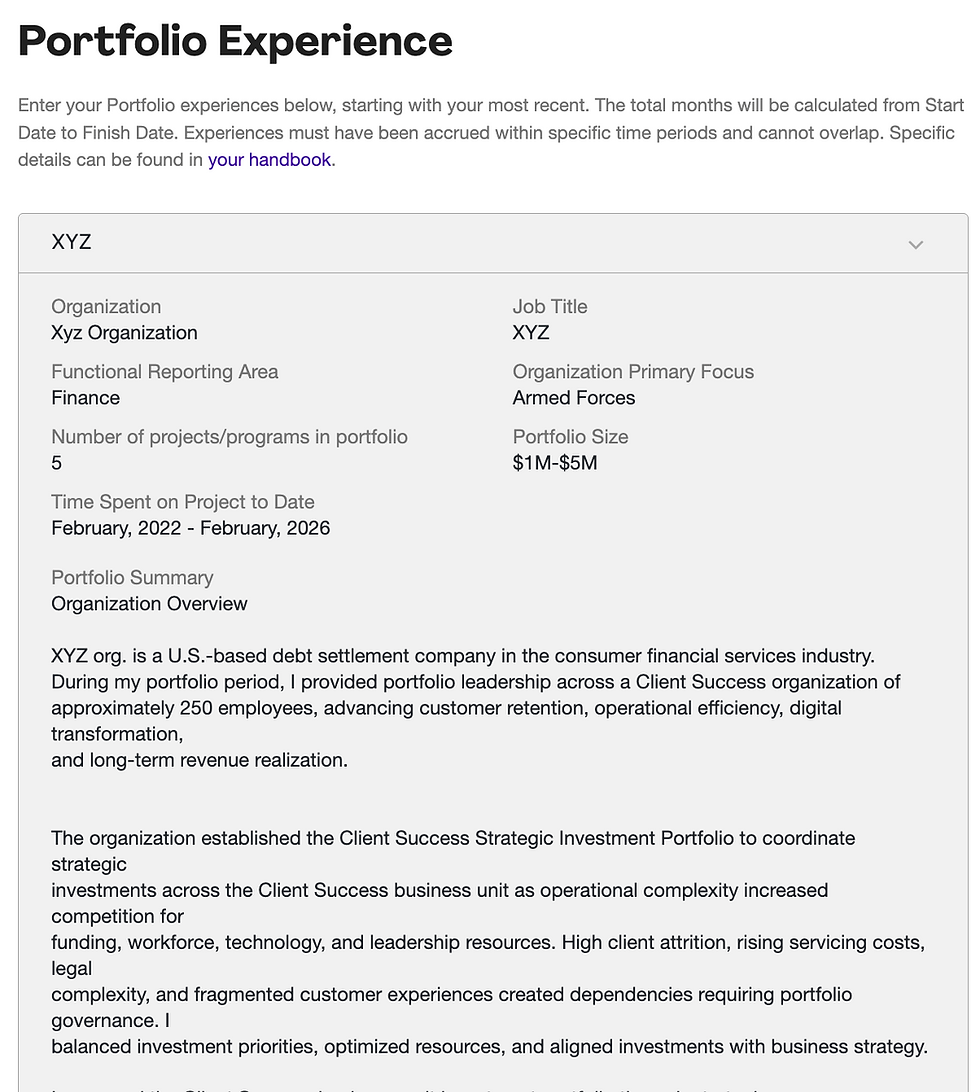
Here is a sample screenshot below of the PfMP professional business experience section showing the different fields.

PgMP and PfMP Application Process
Both PgMP and PfMP are a level above the PMP certification, so the application process is also more daunting, and the assessment is more stringent than that for the PMP. The overall application process for both these certifications is very similar, with critical differences in how you need to write the application and what your area of focus is going to be, based on the certification you are applying for.
For both these certifications, you have two assessments before PMI approves you to take the exam.
When you submit your PgMP or PfMP application, it goes through two steps.
#1 PMI’s Application Completeness Review
The first step is called PMI's application completeness review, where people internally within PMI evaluate whether you have included all the necessary information in the application. There's no significant content or experience review happening at this stage, and approval at this stage comes pretty quickly, generally within a day or two.
#2 PgMP and PfMP Panel Review Stage
The second step is the panel review for your PgMP or PfMP application. This is where PMI sends your application externally to program or portfolio managers for review, and the application rejection rate at this stage is quite high (more than 50%).
The panel conducts a subjective review of your entire program or portfolio description and reviews your program or portfolio management experience summaries.
PMI indicates that the panel review step can take up to 60 days because this depends on the availability of the panel reviewers. However, we have observed that people usually get approved within 30 days, but this can differ from case to case.
Read our article on 8 PgMP Application Rejection Reasons to save yourself from a panel review rejection.


How to Complete the PgMP Program Management Application?
In the PgMP application, there are two distinct parts that you will need to work on.
The first part is the program description, where you need to describe the context of your program and the organization.
We have a complete guide on the [PgMP Application Process – Step-by-Step Guide (2026)], and it will help you understand the entire PgMP Application writing process in depth.
The second part is called the Program Management Experience Summaries, where you will write answers to specific prompts based on your experience in three of the PgMP exam domains: Program Strategy, Program Governance, and Program Leadership. You can think of these prompts as specific questions that you must answer.
To understand how to write panel-ready PgMP program descriptions, you can read our blog post on approved PgMP Application Examples.


How to Complete the PfMP Portfolio Management Application?
Similar to the PgMP application, in the PfMP application, you also need to write the portfolio description and the Portfolio Management Experience Summaries.
The format of the portfolio description is similar to the program description you write in the PgMP application, with the difference being that here you write about a specific organizational portfolio that you managed. Remember that a portfolio comprises projects, programs, and operations.
Additionally, the Portfolio Management Experience Summaries involve writing answers to five prompts related to the five portfolio management exam domains: Strategic Alignment, Governance, Portfolio Performance, Portfolio Risk Management, and Communications Management.
Writing the PgMP or PfMP application can be quite complicated, time-consuming, and daunting for many applicants. The rejection rates for PgMP and PfMP applications are nearly 50%, and it is highly recommended that you consider using personalized guidance and assistance while writing your application. Additionally, the panel is looking for lived program or portfolio management experience rather than bookish jargon.
CareerSprints is a top-rated company that offers personalized guidance and completely tailored writing services for both the PgMP and PfMP applications. Check out our PgMP Application Review and PfMP Application Review services.
CareerSprints also provides review and rewrite services for the PMP Application and has completed 500+ applications successfully.

PgMP vs PfMP Examination
PgMP Exam Format
The PgMP examination consists of 170 multiple-choice questions, of which 150 are scored and 20 are unscored pretest questions. These pretest questions do not affect your exam score.
The allotted time to complete the examination is 240 minutes (4 hours). There are no scheduled breaks during the exam, although you are allowed to take a break if needed. If you take a break, your exam clock continues to count down.
PfMP Exam Format
The PfMP examination also consists of 170 multiple-choice questions, of which 150 are scored and 20 are unscored pretest questions. These pretest questions do not affect your exam score.
The allotted time to complete the examination is 240 minutes (4 hours). There are no scheduled breaks during the exam, although you are allowed to take a break if needed. If you take a break, your exam clock continues to count down.
Both the PgMP and PfMP exams are administered through computer-based testing (CBT) at an examination centre.
PgMP vs PfMP Exam Syllabus
The PgMP and PfMP exams cover different domains based on the responsibilities of program and portfolio managers. Let's look at the exam syllabus for both certifications and the domains you need to focus on when writing your application.
PgMP Exam Syllabus
The PgMP exam covers five domains, with Program Life Cycle Management accounting for the largest proportion of the exam at 44%.
The percentage breakdown of the PgMP exam domains is as follows:
Strategic Program Alignment: 15%
Program Life Cycle Management: 44%
Benefits Alignment: 11%
Stakeholder Engagement: 16%
Governance: 14%
When writing your PgMP application, you need to write answers to prompts covering three of the five domains in your Program Management Experience Summaries: Program Strategy, Program Governance, and Program Leadership.
PfMP Exam Syllabus
The PfMP exam covers five domains, with Strategic Alignment and Portfolio Performance each accounting for 25% of the exam.
The percentage breakdown of the PfMP exam domains is as follows:
Strategic Alignment: 25%
Governance: 20%
Portfolio Performance: 25%
Portfolio Risk Management: 15%
Communications Management: 15%
For the PfMP application, you will need to write Portfolio Management Experience Summaries covering five domains: Strategic Alignment, Governance, Portfolio Performance, Portfolio Risk Management, and Communications Management.

Which Certification Will Be a Better Career Fit for You: PgMP or PfMP?
PgMP and PfMP can both significantly benefit your corporate career, but which one you eventually choose depends on your professional experience and career goals. In recent times, I have worked with a lot of existing PMPs upgrading to the PgMP to differentiate themselves in a crowded and highly competitive job market.
If you already have experience managing multiple related projects to achieve organizational goals, then the PgMP certification may be the next logical step for you. If your experience lies in managing portfolios of projects and programs to achieve organizational strategy and objectives, acquiring the PfMP certification could be a better decision.
Before deciding, make sure you meet the eligibility requirements and understand the application process and exam syllabus for your chosen certification.
If you have any questions about which certification is better for your career or need help with the qualification process, you can always reach out to us at info@careersprints.com.
About the Author and CareerSprints.com
Rohit Gupta is a seasoned PMP and PRINCE2-certified project management trainer with 15+ years of experience training a global audience of more than 50,000 candidates.
He has helped over 500 professionals get their PMP, PgMP, PfMP applications approved and mentored 300+ candidates to earn their PMP certifications. As a lead coach at CareerSprints Inc., Rohit continues to guide project, program and portfolio managers with personalized, real-world preparation strategies.
Rohit is recommended by many PMP exam candidates for his ability to guide them through the PMP and PgMP application process and for his personalized, structured coaching style that helps them achieve certification success.
He also holds other prestigious and in-demand certifications such as ITIL expert, Scrum Master Certification, FCAS certification, DevOps Foundation Certification, AIPM-F certification, FCKB certification and BAF certification.
CareerSprints.com also supports professionals applying for advanced certifications using their PgMP Application Review and PfMP Application Review and Rewrite services, helping them successfully navigate and clear the application process.


Comments